The Anti-Cancer Effects Of The Folk Herb Cephalotaxus (Sanjianshan)
Cephalotaxus, also called feizu (plum yew), is an evergreen tree. Its branchlets are opposite, and its winter buds are terminal. The leaves are arranged spirally in two rows, linear-lanceolate, slightly curved, with white stomatal bands on the underside. The flowers are dioecious (male and female on separate plants); the male strobili are globose with short stalks, each bearing 6–16 stamens and a bract at the base; the female strobili have long peduncles and grow in the leaf axils on the lower part of the branches, composed of nine pairs of decussate bracts, each bract bearing two erect ovules. The seeds are green, drupe-like, with a hard inner seed coat.
Cephalotaxus sinensis, of the Cephalotaxaceae family, is a tree species endemic to China and a plant characteristic of the subtropics. It is distributed in central-south China and in Shaanxi, Gansu, Anhui, Zhejiang, Sichuan, Guizhou, Yunnan and other places. In the eastern provinces it grows at elevations of 200–1000 m; in the southwestern provinces it is found higher, up to 2700–3000 m, in mixed broadleaf and coniferous forests.
Cephalotaxus can reach 20 m in height with a trunk diameter of up to 40 cm; the bark is brown or reddish-brown, splitting into flakes and falling off; the branches are relatively slender, slightly drooping; the crown is broadly rounded. The leaves are arranged in two rows, lanceolate-linear, usually slightly curved, 4–13 cm long (mostly 5–10 cm) and 3.5–4.5 mm wide, gradually narrowing toward the top, with an acuminate long tip at the apex and a cuneate or broadly cuneate base; the upper surface is dark green with a raised midrib, and the underside has white stomatal bands 3–5 times wider than the green marginal bands, with a conspicuous or slightly conspicuous green midrib band. The male strobili are clustered 8–10 together into a head about 1 cm across; the rachis is stout, usually 6–8 mm long, with 18–24 bracts at the base and upper part of the rachis, and each male strobilus has 6–16 stamens with 3 anthers and short filaments. Of the female strobili, 3–8 ovules develop into seeds, with a peduncle 1.5–2 cm long. The seeds are ellipsoid-ovoid or subglobose, about 2.5 cm long; the aril is purple or reddish-purple when ripe, with a small point at the apex; there are 2 cotyledons, linear, 2.2–3.8 cm long and about 2 mm wide, obtuse or slightly notched at the apex, with a raised midrib on the underside and no stomatal lines, and a groove on the upper surface containing a narrow white powdery band. The primary leaves are falcate-linear, the first 5–8 being small, 4–8 mm long, with white stomatal bands beneath. Flowering is in April; the seeds ripen from August to October.
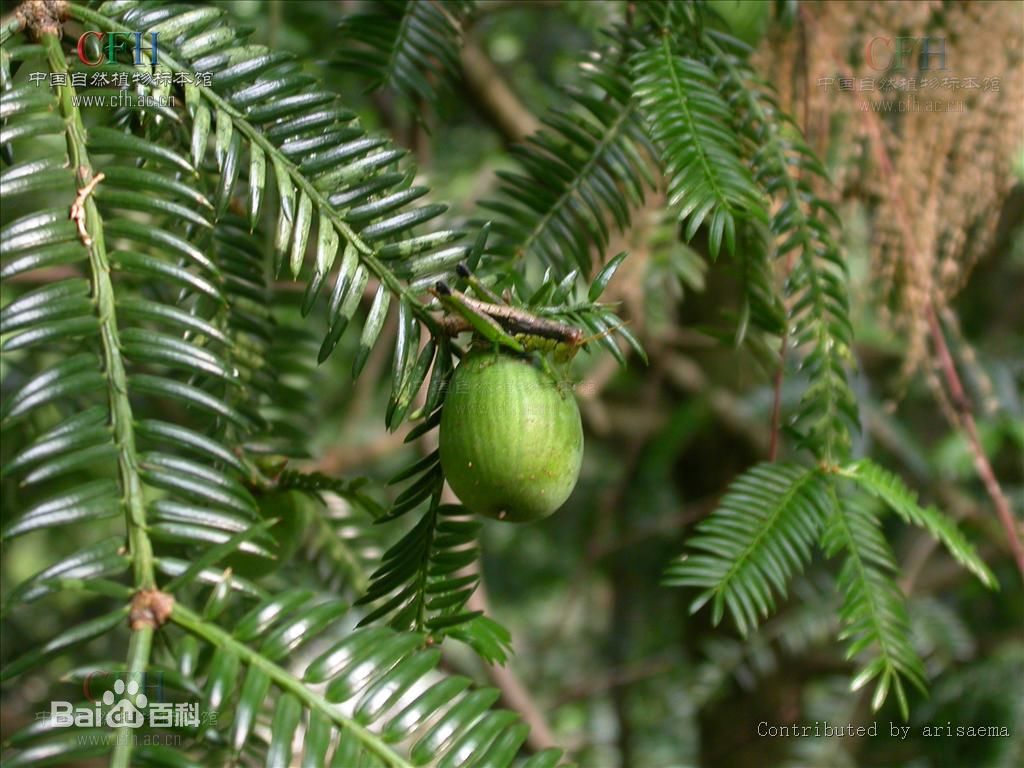
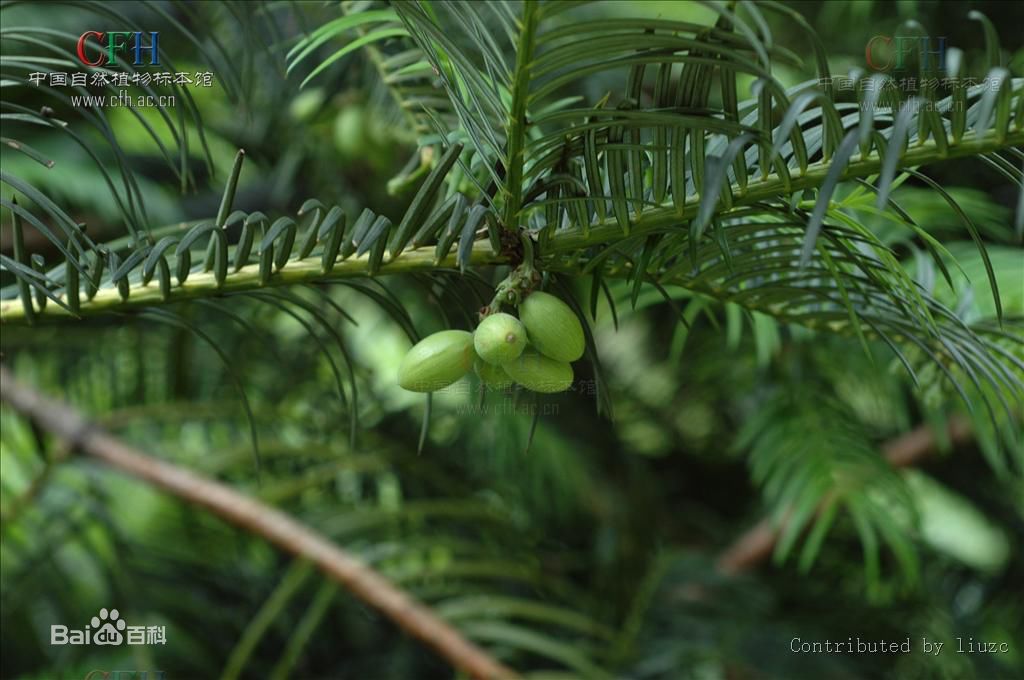
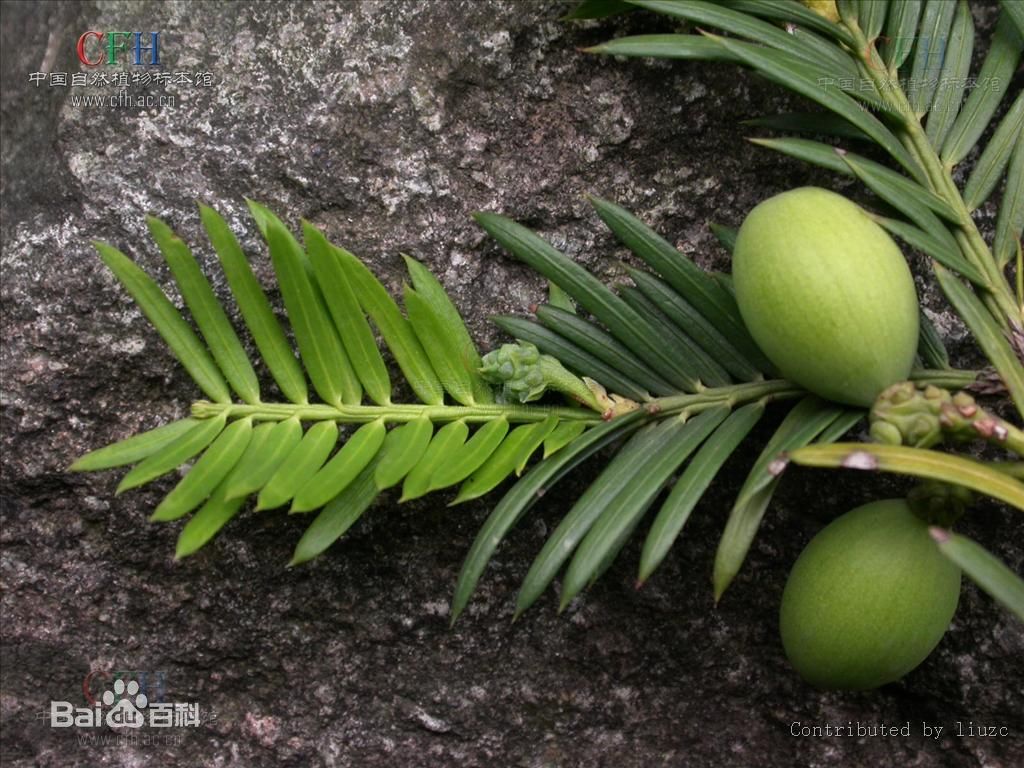
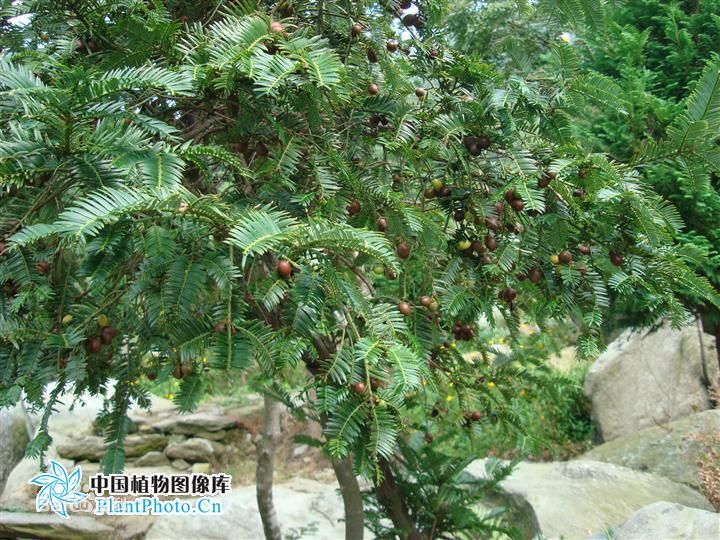
Cephalotaxus as a folk green herb
Cephalotaxus is not a commonly used Chinese medicinal, but in many regions folk herbalists have a tradition of using it to treat unnamed swellings and toxins (quite a few of which were cancers). Not only Han Chinese folk healers use Cephalotaxus medicinally; the folk herbalists of ethnic minorities also use it to treat various diseases.
In Miao medicine Cephalotaxus is called feibajiu or xuebamu; its tender twigs or the whole plant are used for internal bleeding and as an anti-cancer agent (Dian Yao Lu, Records of Yunnan Medicines). Called shuishanshu, heizhongmo by the Xianglan group: the stem bark and tender twigs treat malignant tumors and cough (Xianglan Kao). Called feibajiu, xuebamu: the tender twigs or whole plant mainly treat internal bleeding and cancer (Ethnic Medicines, Vol. II).
In Yao medicine Cephalotaxus is called keke; its root, bark and leaves are used for traumatic injuries and rheumatic pain (Gui Yao Bian, Compilation of Guangxi Medicines).
In Dong medicine Cephalotaxus is called tongbiansui; likewise its root, bark and leaves are used mainly for traumatic injuries and rheumatic pain.
In She medicine Cephalotaxus is called gouweisong, taosong, jiansong, yeifeizi, hushanshu, yanshan and other names; its root, stem, seeds and leaves are used for ascariasis, hookworm disease, scrofula (lymph node tuberculosis, lymphoma, etc.) and cancer (She Yao Yi, She Materia Medica).
How Cephalotaxus' anti-cancer action was discovered
Harringtonine (feizijianjian, also called sanjianshan shijianjian), homoharringtonine (gaofejianjian, also called gaosanjianshan shijianjian), and the total alkaloids of Cephalotaxus, extracted from the plant, are now widely used clinically, though they have been classified as Western chemotherapy drugs for treating malignant lymphoma, leukemia, breast cancer, rectal cancer, gastric cancer, polycythemia vera and other diseases.
In the mid-20th century an American scholar found locally grown Cephalotaxus in Taiwan, discovered its anti-cancer activity and studied it, but progress was slow. Later, the famous Fujian physician Professor Pan Mingji (now deceased), while treating patients, happened to meet a young man from the Jianyang Pharmaceutical Factory who recommended Cephalotaxus to him, claiming it could be used against cancer. Professor Pan had also encountered patients in his clinic who had bought Cephalotaxus roots from folk herbalists; after taking the roots they developed a series of reactions that drew his attention. He then began to study the anti-cancer activity of Cephalotaxus.
One of Professor Pan's patients, after chemotherapy failed, took Cephalotaxus on his own. As the herb-grower had taught him, the cancer patient selected two root pieces about 3 cm in diameter and 10 cm long, washed them, added lean pork washed and sliced, stewed them for one hour, poured out two bowls of thick decoction, and took it in two divided doses. As a result he developed severe gastrointestinal discomfort—retching, vomiting and diarrhea. (It is worth noting here that many patients, upon developing discomfort after taking Chinese herbs and folk herbs, abandon treatment out of fear, which is a great pity.) Professor Pan Mingji was originally trained in Western medicine; after experiencing the strengths of TCM in clinical practice he switched to studying Chinese medicine and later became world-famous for researching integrated Chinese-Western anti-cancer treatment. Professor Pan himself was also a cancer patient, yet relying on his rich knowledge of both Chinese and Western medicine he survived for decades, living to over eighty.
From the patient's adverse reactions Professor Pan saw that Cephalotaxus had a cytotoxic effect—exactly the kind of reaction commonly seen after Western chemotherapy drugs. He therefore became keenly interested and decided to study its anti-cancer action. Cooperating with the Jianyang Pharmaceutical Factory, he purified Cephalotaxus and made it into injections, carrying out animal experiments on tumor-bearing mice. After repeated animal experiments he finally found a safe and effective dose, and the tumors on the tumor-bearing mice were markedly reduced. Later the Cephalotaxus preparation was developed by the Fuzhou Pharmaceutical Factory, with Professor Pan still in charge of clinical trials. At that time Professor Pan was a key physician in the oncology department of Fuzhou First Hospital. Through clinical observation from animal experiments to human trials, he found that Cephalotaxus had a certain effect against malignant lymphoma, leukemia, lung cancer, pancreatic cancer, liver cancer and gastric cancer.
Pan Mingji's research drew the attention of the Ministry of Health. This was during the Cultural Revolution; Director Xie Hua of the Military Control Commission of the Ministry of Health valued Pan's materials and proposed establishing a "National Cephalotaxus Research Coordination Group," with Fujian chosen as the lead. Professor Pan continued to direct the anti-cancer research. After many years of effort, the Cephalotaxus anti-cancer research finally achieved certain results; it was later determined that the monomers with the most outstanding clinical efficacy were the extracted compounds homoharringtonine and harringtonine. Using them to treat non-lymphocytic leukemia, especially acute monocytic leukemia, has become among the best drugs internationally.
Properties, functions, indications, usage and dosage of Cephalotaxus
According to traditional TCM theory, Cephalotaxus is bitter and astringent in taste and cold in nature.
Functions and indications: breaking blood and stopping pain, reducing swelling and healing sores, killing parasites and resolving toxins; anti-cancer. It is used mainly for malignant lymphoma, leukemia, lung cancer, gastric cancer, esophageal cancer, rectal cancer and breast cancer.
Usage and dosage: it is usually prepared as an injection. If used as a decoction, the dose is 6–15 g, which may be appropriately increased for anti-cancer use. Folklore also has a method of stewing Cephalotaxus with lean pork for oral use.
Toxicity: the toxicity of Cephalotaxus is mainly expressed as suppression of the hematopoietic system, together with irritation of the digestive tract, causing loss of appetite, nausea, vomiting and reduced white blood cell count.
Purification and preparation method of Cephalotaxus
Method for preparing harringtonine injection: take 100 kg of coarse powder of Cephalotaxus trunk, percolate with 80% ethanol; after percolation, recover the ethanol under reduced pressure and concentrate. Adjust the concentrate to pH 2–3 with 5% hydrochloric acid and filter; adjust the filtrate to pH 9.5 with sodium carbonate. Extract with chloroform and recover the chloroform to obtain a brown-black alkaloid extract. Dissolve this extract in 0.5 mol/L hydrochloric acid and filter; repeatedly extract the precipitate with acid solution until the filtrate shows no alkaloid reaction. Combine the filtrates, adjust to pH 4–5 with ammonia water, and extract with chloroform to remove non-harringtonine substances; then adjust further with ammonia water to pH 8–9 and extract with chloroform until the alkaloids are fully extracted. After recovering the chloroform, add twice the amount of absolute ethanol to the extract, stir to dissolve, refrigerate, and filter the precipitate to obtain crude harringtonine. Add alumina to the filtrate, stir, remove the ethanol, dry and sieve, pack into a chromatographic column, elute with ether, and recover the ether to obtain harringtonine for injection. Dissolve a set amount of harringtonine in 5% or 10% glucose injection for use. This product is a white or slightly yellow crystalline powder. It clears heat and fights cancer, and is used for leukemia and other conditions. For intravenous drip: for patients with acute myeloid leukemia, blast crisis of chronic myeloid leukemia, or acute lymphoblastic leukemia, the dose is 0.2–0.3 mg/kg once daily; for chronic myeloid leukemia the dose is 0.3–0.45 mg/kg once daily. (Excerpted from Compilation of Chinese Pharmaceutical Preparations.)
The mechanism of Cephalotaxus' anti-cancer action
The total alkaloids of Cephalotaxus inhibit mouse sarcoma S180, rat Walker 256, mouse leukemia L615, and mouse brain tumor B22, and can markedly prolong the survival time of tumor-bearing mice. Harringtonine, homoharringtonine, deoxyharringtonine and isoharringtonine markedly inhibit mouse lymphoid leukemia P388, L1210, Lewis lung carcinoma and other tumor lines. In addition, harringtonine and homoharringtonine have anti-tumor effects against cultured sarcoma, breast cancer, ovarian cancer, endometrial cancer (adenocarcinoma) and melanoma in vitro. The main mechanism of their anti-tumor action is an effect on protein and DNA synthesis. They inhibit protein synthesis in both the G1 and G2 phases of tumor cells, delaying their transition from G1 to S and from G2 to M; they kill S-phase cells and also kill some G0 cells.
Harringtonine can induce cultured human promyelocytic leukemia cells to differentiate into nearly normal monocytes and lose their proliferative capacity.
The toxicity of Cephalotaxus
The toxicity of the total alkaloids of Cephalotaxus is mainly divided into acute toxicity, chronic toxicity and cytotoxicity. Excessive use causes respiratory-circulatory failure or internal hemorrhage and death in experimental animals. Chronic toxicity is mainly manifested as suppression of the hematopoietic system and declines in white blood cells, platelets and hemoglobin. It can also cause myocardial damage, sinus tachycardia, arrhythmia and gallop rhythm; individual cases show neurological symptoms and hair loss. The cytotoxicity is mainly reflected in the ability of harringtonine to induce chromosomal aberrations and destruction in non-cellular and bone marrow cells.