A Concise Introduction to TCM Pulse Diagnosis (Part 1)
"Looking, listening-smelling, asking, and palpating" are the four examinations of TCM—the four common methods of diagnosing disease.
Palpation includes pulse-taking and abdominal palpation. Pulse-taking, also called feeling the pulse, laying on the pulse, or reading the pulse, is the diagnostic method that best embodies the distinctive character of TCM.
Abdominal palpation is not harakiri; it means the physician uses his own hands to palpate and probe the patient's abdominal and thoracic cavities, also called abdominal diagnosis. Abdominal diagnosis is also a method that can help the doctor determine what disease the patient has.
However, because the feudal tradition forbidding physical contact between men and women in Chinese society was so strong, abdominal palpation as a clinical diagnostic method has basically vanished from TCM circles in China. In Japan, however, it has been well preserved.
Katsu Inaba and others of Japan wrote dedicated works on abdominal palpation such as Fushin Kiran (Essentials of Abdominal Diagnosis). Interested readers are advised to obtain and study them. Abdominal diagnosis combined with pulse diagnosis yields more accurate diagnoses and more targeted medication, improving clinical efficacy.
Abdominal diagnosis is complex; readers can consult works such as Fushin Kiran on their own. In this article, I will only discuss the introductory knowledge of TCM pulse diagnosis.
TCM pulse diagnosis has a long history. In the oldest TCM work, the Huangdi Neijing (Yellow Emperor's Inner Canon), there are already extensive records on pulse diagnosis. Throughout history and across the world, books on pulse diagnosis are beyond counting, and learning it is no easy task.
But whether for patients or for students of TCM, it is necessary to understand the basic common sense of pulse diagnosis.
I believe everyone is familiar with TCM pulse-taking: the patient sits still, the doctor lays three fingers of one hand on the patient's wrist, feels the patient's pulse, and writes down the pulse pattern he has diagnosed. This record is called a pulse case (mo'an) in the TCM profession and is part of the medical case record.
Pulse-taking is a good, non-invasive way to examine the body; pulse diagnosis has a certain scientific basis. In the past, doctors did not have today's sophisticated diagnostic equipment, so they could only use this seemingly simple but actually difficult means of detection to judge the patient's condition.
Pulse diagnosis embodies the essence of TCM thought of "observing the exterior to know the interior." The depth, speed, and strength of a person's pulse beats follow certain regularities. If the pulse deviates from the normal pattern, it indicates that the person's body indeed has a health problem.
So what is this general regularity?
TCM takes the "normal person's pulse"—that is, the pulse of a healthy person—as the reference to judge what is a morbid pulse.
The normal pulse differs with the seasons: wiry in spring, hooked in summer, hairy in autumn, and stonesome in winter. Each season has one normal pulse: the wiry (xian) pulse is common in spring, the surging (hong) pulse (hooked) in summer, the floating (fu) pulse (hairy) in autumn, and the deep (chen) pulse (stonesome) in winter. This is the general rule.
There are also general rules such as: children tend to have a rapid pulse; athletic people often have a deep, slow pulse; a person's fatness or thinness affects the floating/deep quality of the pulse; young adults often have a slippery (hua) pulse. These general rules must also be remembered, otherwise misdiagnosis easily occurs.
Generally speaking, taking the pulse on an empty stomach in the morning is the most accurate. The Suwen's "On the Essence-Signal of Pulse Conditions" emphasizes that taking the pulse at daybreak is best. Because in the morning a person has just risen, has not moved about much, and is on an empty stomach, the pulse is least disturbed and most precisely reflects the body's condition.
If this cannot be managed, at least do not see a doctor for pulse-taking immediately after vigorous exercise or a full meal; such a pulse reading can hardly reflect the body's true state.
Common pulse patterns include the floating, deep, rapid, slow, slippery, wiry, fine, weak, deficient, and long pulses, among some thirty in total, plus seven strange pulses such as the sparrow-pecking, rooftop-dripping, and shrimp-surfacing pulses. I will introduce these one by one in detail in later articles.
Although pulse study is complex, there are some outlines to follow.
The Yixue Chuanxin Lu (Records of Medical Transmission to the Heart) contains a "Pulse-Taking Transmission Verse," whose first four lines are: "The essentials of pulse-taking are four pulses—the floating, deep, slow, and rapid serve as the standard. Floating and deep are sought by the lightness or heaviness of the fingertip; slow and rapid are judged by the slowness or urgency within one breath." These four lines are the basic outline of TCM pulse diagnosis.
Furthermore, TCM pulse patterns can be summarized into just three types: the normal pulse, the excess pulse, and the deficient pulse. The normal pulse is the healthy pulse; the excess pulse is stronger than the normal; the deficient pulse is weaker than the normal.
If one takes this verse from Yixue Chuanxin Lu, together with the excess and deficient pulses, as the outline of pulse study, then learning the other pulse patterns will not be difficult.
I have drawn a diagram here that basically summarizes the characteristics of TCM pulse patterns.
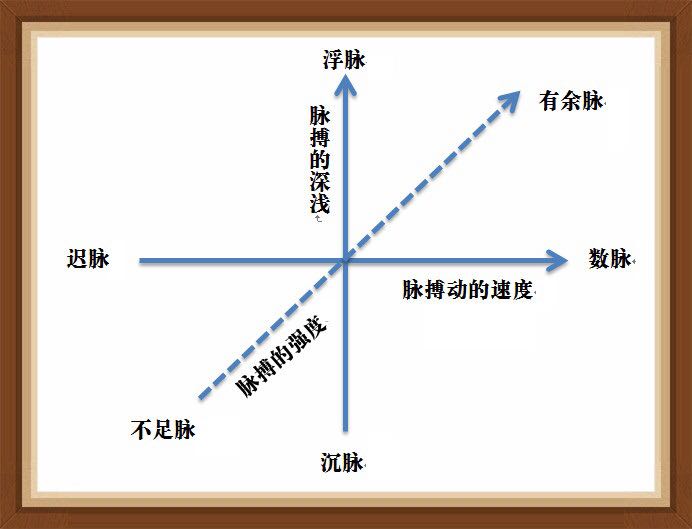
Whether a pulse is slow or rapid is distinguished by the speed of the beats. Within one exhalation and inhalation, a pulse beating four to five times is the normal pulse; fewer than four beats is the slow (chi) pulse; more than five is the rapid (shu) pulse. A pulse felt with light pressure is the floating pulse; one requiring pressure to feel is the deep pulse. A pulse of moderate strength is the normal pulse; a relatively weak beat is the deficient pulse; a relatively strong beat is the excess pulse.
Different pulse patterns call for entirely different medication principles in TCM. Therefore, TCM cannot prescribe recklessly based solely on Western test results or on a disease name the patient reports to the doctor; that will not only fail to treat the disease but may kill people.
Generally, a slow pulse indicates coldness and should be treated with warming, heat-dispersing herbs. A rapid pulse indicates heat (the rapid pulse is the most complex, and I will discuss it separately in future), and should be treated with cold-cool or yin-nourishing herbs. A floating pulse indicates an exterior pattern and should be treated by sweating to release the exterior; a deep pulse should be treated as interior disease. Deficient pulses require supplementation; excess pulses require purgation. A hair's breadth's error leads to a thousand-li mistake.
If the pulse is read wrong, the disease cannot be cured. Prescribing without taking the pulse and curing is purely a blind cat bumping into a dead mouse; in most cases, not making things worse would already be a blessing.
These are some of the basics of TCM pulse diagnosis. In future I will introduce more detailed knowledge of TCM pulse diagnosis in several installments.