How I Anti-Age and Prevent Disease
Personally, I do a few things quite well when it comes to anti-aging. I am forty-one this year, but most people who meet me for the first time mistake me for being under thirty; a few years ago I was still often treated as a college student. For a while I volunteered at Longquan Temple, and many people at the construction site thought I was a freshman who had just started university—though by then my son had already graduated from primary school.
Some old friends I have not seen for years are astonished, after seeing me, that compared with twenty years ago my appearance has basically not changed much, and that I even look better now than before. My skin is also well protected, which some women cannot help envying. This has to do with my having been born by the Yangtze River, where many people have good skin; it also has to do with my own lifestyle habits over the years, but not with skin-care products. I only use the cheapest moisturizers like Dabao in autumn and winter, and in spring and summer I do not even use Dabao.
My physical condition now is indeed no worse than when I was twenty, and one might even say a little better. This is because, after studying medicine, I knew how to take care of my body and keep it from aging prematurely. Many of my classmates and childhood friends look more than ten years older than I do. At my age, most people's faces show more or less the traces of time, but time seems to have forgotten me.
I think the most successful thing I have done is to persist in going to bed early and rising early for many years. I usually go to sleep before nine in the evening, which most urban white-collar workers cannot manage. For many people, nine at night is when their nightlife has just begun, and many stay up until after twelve before sleeping. Over time, they become stubborn insomniacs.
In the morning I get up between four and six; before this year I mostly got up at four. After supplementing some vitamin B this year, my sleep quality is a little better than before, and now I can generally sleep until around five to five-thirty. People who stay up late often die suddenly and also get cancer more often, but people who go to bed early rarely die suddenly.
I also control my diet quite well: I do not smoke, do not drink, and almost never gorge on big fish and meat. My diet follows the principle of "plant-based as the mainstay, with a rich variety"; the types of vegetables and fruits I eat each day are basically around 5–10.
Breakfast at my home is usually congee or soy milk, with steamed buns or pancakes and one or two vegetable dishes. Occasionally I eat a boiled egg or a few slices of spiced beef, and my child drinks a glass of milk from time to time. At noon, when I am alone at home, I often eat some simple noodles or fried rice. Usually I cook noodles with three or four kinds of side ingredients, and the combination varies from day to day; most often it is greens, potato, Chinese yam, mushrooms, tomatoes, and the like. Dinner is some whole grains and fruit. We are not vegetarians; at festivals, or when the family all wants a meal of fish or meat, we will cook one. I take in 1–1.5g of salt per meal, and 3–6g of salt per day.
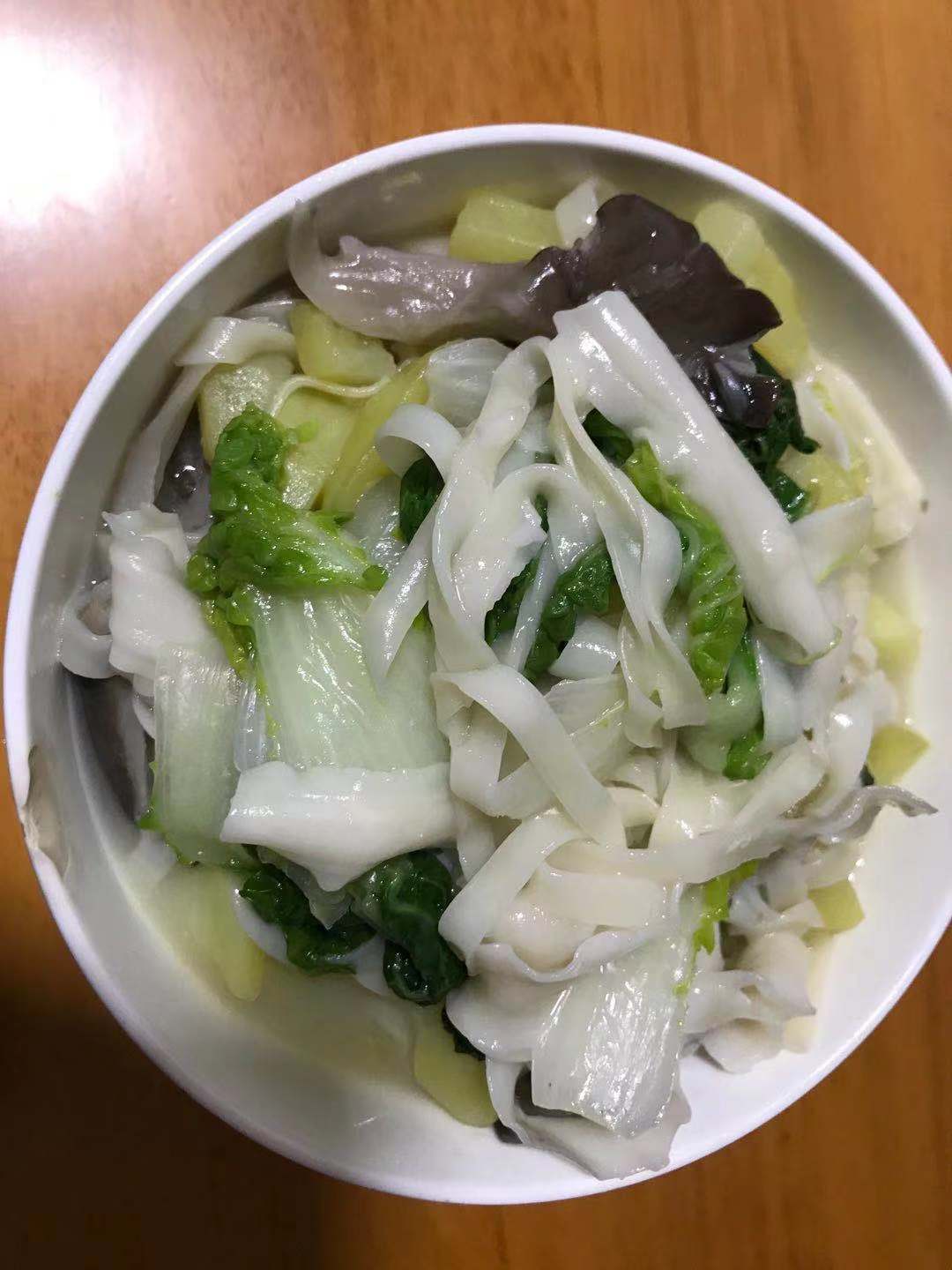
This is my lunch today: a large bowl of noodles cooked together with potato, greens, and mushrooms, with no additives other than oil, salt, and water—when I cook for myself I use no condiments at all, following precisely the principles of dietary variety and a plant-based diet, with only one gram of salt. Many people may feel that eating this way is too bland; in fact, taste is a matter of habit, and once you are used to it you will not find it bland. My personal experience is that when many kinds of food are cooked together and the heat is well controlled, the taste is very good.
I also eat some fruit, basically following the seasons and eating seasonal fruit. Because it is cheaper this way, and the nutrition and taste of the fruit I eat are also the best; I eat about 250g of fruit a day.
For many years my life has been "taking a stroll in place of riding"; when I can walk, I do not ride a bike, and when I can ride a bike, I do not take a vehicle. After reaching middle age, I also reduced strenuous exercises that easily harm the knees and joints, such as mountain climbing and running, and have come to prefer exercise that damages the joints less, such as cycling and swimming. I rarely take elevators; no matter how tall the building, I like to climb the floors one by one. So I have not been obese; I occasionally joke with people that I have a lot of "back fat," but actually my figure is fairly well maintained.
This year I lost more than ten jin through cycling, which resolved the problem I had before of excessive epidural fat from too long spent at a desk; now my lower back and legs no longer hurt—the problem of lower-back and leg pain had tormented me for several years, and was only diagnosed last year as excessive epidural fat. I think this may have to do with my having done too much desk work over the long term. So starting this year, I made a fairly big adjustment to my lifestyle, extending my daily exercise time to 2–3 hours; after increasing the amount of exercise, my lower-back and leg pain was cured without treatment.
Our whole family rarely catches cold; even when we do, I take measures immediately as soon as a sign appears. When family members catch cold from the cold, I use a hair dryer to blow the Dazhui acupoint (GV 14) or the spine, or boil some ginger-and-scallion water to drive out the cold for them. Generally, after such handling, it rarely develops into a severe cold; in most cases, after treatment, a night's sleep sets it right. For summer colds I use some patent medicine such as Huoxiang Zhengqi Wan, or brew some mint tea with fresh mint I grow myself, and it is also cured within a few hours. So in our family there has been no case of a family member getting a severe cold and going to the hospital for IV drips. From kindergarten to high school, my son has taken only one sick day off, and that was because the food in the school cafeteria was unclean, causing him diarrhea. We do get some minor ailments, but in most cases I solve them myself with very simple common medicines.
I keep a not-too-close, not-too-distant distance from people; I do not like getting too close to others, which keeps me from being drawn into human disputes and lets me live very relaxed. I have a few friends I can call confidants; between us all we adhere to the principle that "the friendship of gentlemen is as plain as water," and have not developed into drinking-and-eating friends—too many drinking-and-eating friends fall out and become enemies.
Reading keeps me calm and at peace most of the time. As the Bible says, there is no new thing under the sun. Through reading, I can make sense of the great majority of things that happen in this world, and once I understand them I do not get especially agitated.
If a person's diet is well balanced, they exercise moderately, their mind is at peace, and their emotions are stable, basically not too many diseases will trouble us. As long as one can persist in living this way, one will not age so fast. If no accident occurs, I may live to a great age. Anti-aging and preventing disease are very simple matters, but in this world, the simpler something is, the harder it often is to do well.