Multiple Metastases of Leiomyosarcoma Markedly Shrank After One Month of TCM Treatment
The patient, Li, female, age 51, from Dongying, Shandong, was a circle friend of the Sina cancer patients' circle. First seen October 19, 2015. Before the visit, B-ultrasound at a local hospital showed that the patient's leiomyosarcoma had metastasized to multiple sites distributed within the abdominopelvic cavity; four of the masses were huge tumors: the largest in the right lower abdomen measured 12.3 x 6.3 cm, the largest in the left lower abdomen 7.1 x 6.0 cm, the largest in the left upper abdomen 5.0 x 4.2 cm, and the largest in the right upper abdomen 6.6 x 4.7 cm.
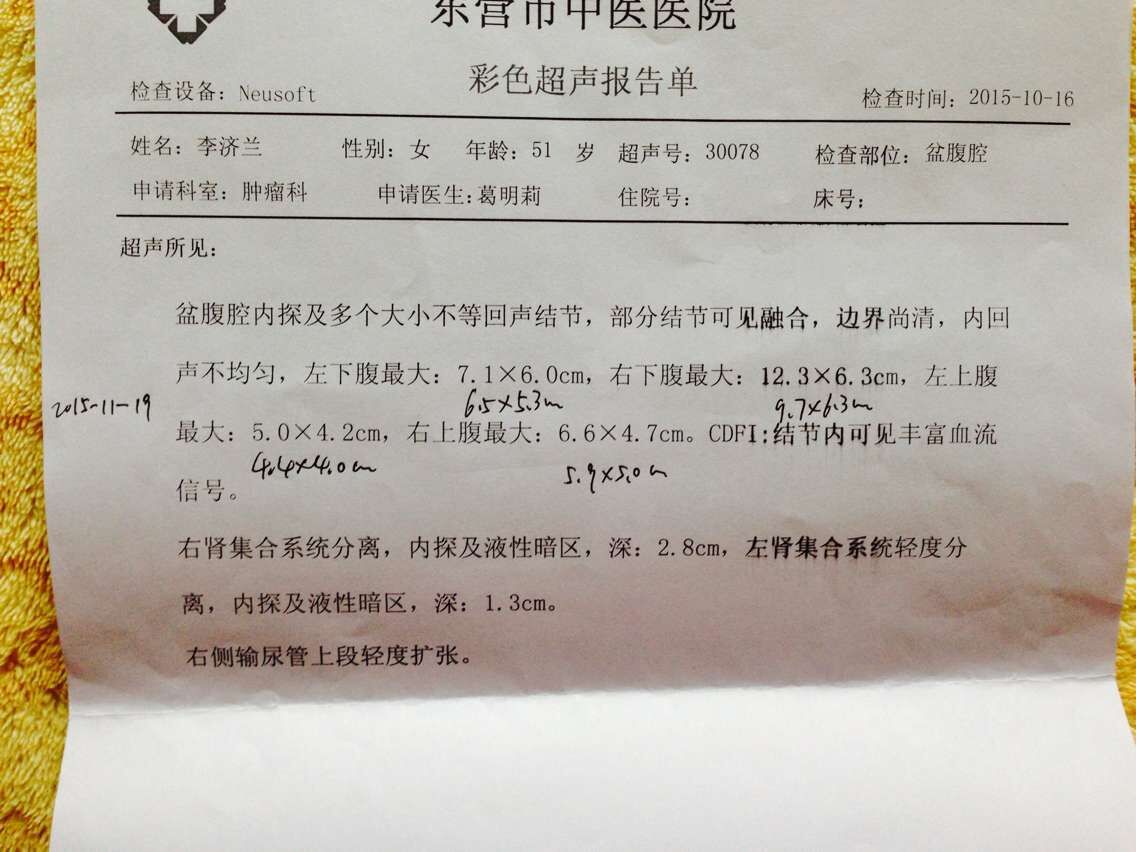
The patient had had the tumor for five years and had undergone surgery, radiotherapy, and chemotherapy on multiple occasions; previously she had been treated at famous hospitals such as Peking Union Medical College Hospital and Shanghai Zhongshan Hospital, but the tumor kept recurring, and Western medicine had few remaining options. After learning of me through the author's blog, she came to Beijing on October 19, 2015 for an in-person consultation.
First visit: left pulse deep, fine, and forceless; right pulse wiry and fine; tongue pale white, light in color; body-surface temperature low, especially obvious over the tumor sites. Examination of the patient's wrist revealed multiple white patches; the patient reported that before the tumor was discovered there had been multiple white patches or red rashes on the body surface, which decreased after surgery. Earlobes had no nodules; not anemic; blood sugar on the low side. Whole-body fatigue; profuse sweating on the head after sleep or after sitting long; dry mouth but no desire to drink, preferring warm water; stomach discomfort after catching cold; stools had been normal before surgery. Hydronephrosis.
Synthesizing the pulse signs and physical signs, I judged the patient's tumor to be the yin nodules (yinju) described by Wang Hongxu; treatment should follow the principle of warming yang and unblocking the interstices, centered on Yanghe Decoction and Xihuang Pills. The prescribed formula was:
Prepared Rehmannia (Shudi) 40g, deer-horn glue (Lujiaojiao) 12g (melted), white mustard seed (Baijiezi) 8g, raw licorice (Sheng Gancao) 4g, cinnamon (Rougui) 4g (ground and taken in a draft), blast-fried ginger (Pao Jiang) 2g, raw Ephedra (Sheng Mahuang) 2g, Bupleurum (Chaihu) 12g, Scutellaria (Huangqin) 12g
One dose daily, taken early in the morning or before bedtime in a single portion.
Additionally, Xihuang Pills once daily, starting at 3g, increasing by 3g each day up to 12g. Alternate with the decoction morning and evening: if the decoction is taken in the morning, take the pills in the evening, and vice versa.
Jinkui Shenqi Pills taken according to the package insert.
Take the medicine for one week, stop for one week, then continue for one week, cycling on and off in this way. The patient was told that gastrointestinal adverse reactions, drowsiness, and other as-yet-unknown side effects might occur.
Several days after starting the medicine, the patient's body-surface temperature changed, running higher than before; the temperature over the tumor skin changed noticeably; head sweating after sleep ceased, though sweating appeared on the neck. The first week produced no obvious side effects; after the first week she began the off-week. Two days into the stop period the patient grew anxious, feeling that stopping treatment for a week and letting the tumor run wild was too risky, and asked to continue. A few days after resuming, gastrointestinal adverse reactions began—vomiting, stomach pain, acid regurgitation, back pain; I instructed her to persist with the stop period. The side effects disappeared after two days off. But thereafter, when the stop period ended and she resumed the medicine, severe vomiting returned within less than two days.
I instructed her to add Inula (Xuanfuhua) 10g, processed Pinellia (Fa Banxia) 10g, tangerine red (Huajuhong) 10g, and persimmon calyx (Shidi) 10g to the previous formula and continue.
After one month of on-and-off dosing, the patient was re-examined on November 19, 2015, before this article was written. The largest left-lower-abdomen tumor had shrunk from 7.1x6.0 to 6.5x5.3; the largest right-lower-abdomen tumor from 12.3x6.3 to 9.7x6.3; the left-upper-abdomen tumor from 5.0x4.2 to 4.4x4.0; the largest right-upper-abdomen tumor from 6.6x4.7 to 5.9x5.0. All of the body's huge tumors had shrunk markedly.
This patient's treatment experience shows that Chinese medicine does indeed produce immediate results for some tumor patients, and the speed is no slower than chemotherapy. But in the course of treatment, some unsatisfactory side effects inevitably appear; after they appeared, the patient at first panicked and was doubtful, but because all available Western therapies had failed, she had no choice but to grit her teeth and continue the Chinese herbs.
In treating this patient I was also uneasy, because her condition was already very severe: all four huge tumors had reached a life-threatening size. If treatment failed, it might delay her chance of survival, so I repeatedly urged her to return for timely re-examination and, if treatment proved ineffective, to immediately seek another good doctor so as not to forfeit her chance.
This patient's tumor is still under treatment; I will continue to faithfully record the therapeutic results for the reference of other physicians and patients.
November 28, 2015: second in-person consultation.
After the previous medicine, head sweating lessened but neck sweating increased; still sweating profusely after sleep; fatigued and disinclined to move; skin color normal; tongue coat basically normal; frequent sour taste in the mouth; dry mouth; lower back sore and weak; pulse wiry and forceful; body temperature risen to above 36°C (previously it had basically been below 36°C); urine yellow; left-sided hydronephrosis decreased, right-sided hydronephrosis increased.
Since the treatment was effective, the formula was not changed; only minor adjustments were made to the previous therapeutic approach, as follows:
Prepared Rehmannia (Shudi) 40g, deer-horn glue (Lujiaojiao) 12g (melted), white mustard seed (Baijiezi) 8g, tangerine red (Juhong) 2g, blast-fried ginger (Pao Jiang) 2g, Ephedra (Mahuang) 2g, cinnamon (Rougui) 4g (ground, taken in draft), raw licorice (Sheng Gancao) 4g, Poria (Fuling) 8g, processed Pinellia (Fa Banxia) 12g, fried Gardenia (Chao Zhizi) 8g, fried Atractylodes (Chao Baizhu) 12g, stiff Silkworm (Jiangcan) 12g, Codonopsis (Dangshen) 12g
One dose daily, taken in a single portion after breakfast.
Optionally add cicada slough (Chantui) 6g and turmeric (Jianghuang) 6g; I asked the patient herself to compare the difference between adding and not adding them, and then choose whether to add them.
Xihuang Pills: day 1, 6g; day 2, 9g; days 3 through 7, 12g, taken all at once before bedtime, washed down with yellow rice wine.
Seven days on, seven days off.
During the off period, soak dried toad skin (Gan Chanyi) in yellow rice wine and apply it externally over the tumor sites.