Walnut Kernel (Hutaorou / Hutaoren): Both Food and Medicine
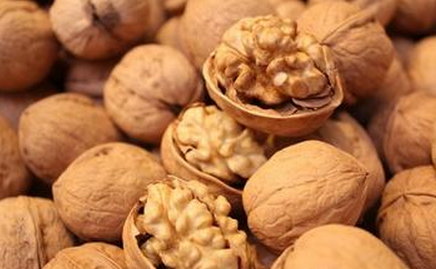
Hutaorou, also called Hutaoren, is the kernel of the English walnut. It is both a delicious food and a potent medicinal. Both the leaves and fruits of the walnut contain juglone; in mice with ascites-type liver cancer, juglone prolonged survival by as much as 95%, and its inhibition rate against Sarcoma 180 reached as high as 50%. It is therefore an excellent anti-cancer food. It may be decocted, eaten directly, or used externally.
When decocted, the usual dose of Hutaorou is 9–15 g; when chewed and swallowed on its own, the usual dose is 10–30 g. Excessive consumption is not advisable. Many TCM classics record that overeating Hutaoren “moves phlegm-rheum, causing nausea, vomiting of water and food,” and that “eating too much stirs wind and makes the eyebrows fall; taken together with wine, it often causes coughing of blood.” Patients with lung-heat especially should not eat too much, for overindulgence “ignites mingmen fire and causes yin deficiency with vomiting and nosebleed.” Those with poor gastrointestinal function and frequent diarrhea should also avoid it, since walnut kernel worsens diarrhea. In addition, walnut kernel should not be taken together with strong tea.
According to TCM theory, the main action of Hutaorou is to tonify the kidney. It is used for lower back pain and weak legs due to kidney-qi deficiency, dizziness and fatigue, frequent urination, and seminal emission. Hutaoren is sweet in flavor, warm in nature but not drying; it can gently tonify both liver and kidney, boost essence, and strengthen the body. Thus in the Taiping Huimin Heji Jufang, Qing'e Wan uses it together with Duzhong (Eucommiae Cortex) and Buguzhi (Psoraleae Fructus) to treat lower back pain with weak legs, a heavy sagging sensation in the lower back, and difficulty rising and sitting. Hutaoren is also used for panting and cough due to dual deficiency of lung and kidney, for it astringes the lung, supplements the kidney, and secures and grasps the original qi. For chronic cough that does not cease due to lung deficiency, Hutaoren may be combined with Kuandonghua (Tussilaginis Farfarae Flos) and Ziyuan (Asteris Radix) to astringe the lung and stop cough, or with Renshen (Ginseng) and Xingren (Armeniacae Semen) to both supplement and astringe the lung—as in Renshen Hutaotang recorded in the Ji Sheng Fang. When both lung and kidney are deficient and qi fails to be grasped, presenting with qi-deficiency panting, more exhalation than inhalation, inability to lie flat, fatigue and spontaneous sweating, and aching weakness of the lower back and knees, Hutaoren is often used together with Renshen, Shudi (Rehmanniae Radix Praeparata), and Gejie (Gecko) to warm and supplement lung and kidney, grasp qi, and settle panting.
Hutaoren also moistens the intestines and frees the stool, especially in deficient or elderly patients. Because it is moist and rich in oil, chewing and swallowing it alone can relieve constipation. It may be combined with Huomaren (Cannabis Semen), Yuliren (Pruni Semen), and Roucongrong (Cistanches Herba) to enhance the effect.
The ancients also used Hutaoren for lin syndromes (stranguria) and insufficient lactation. It has the merit of unblocking and moistening the triple-burner vessels. For stone lin due to kidney deficiency with damp-heat pouring downward in the bladder—scant urine, dribbling, and painful urination—it may often be eaten alone, or combined with herbs that clear heat and promote urination such as Qumai (Dianthi Herba) and Dengxincao (Junci Medulla). For insufficient breast milk postpartum, women may also eat more Hutaoren, or combine it with Sheng Maiya (unprocessed Hordei Fructus Germinatus) and Chuanshanjia (Manis Squama).
Hutaoren also activates blood and resolves stasis, reduces swelling and stops pain, and detoxifies and engenders sores. It can treat luoli (scrofula), eczema, and the like. Luoli is what today is called tuberculous lymphadenitis or lymphoma. For traumatic injuries, walnut kernel may be taken with warm yellow wine. For various luoli, welling-abscesses, back ulcers, and bone-deep abscesses, walnut kernel may be ground together with Huaihua (Sophorae Flos) into a powder and taken stirred into hot wine. For luoli, the walnut kernel together with its shell may be charred, ground with pine resin, and applied externally while walnut kernel is taken internally.